Speaking in Anaheim, California at the 241st National Meeting of the American Chemical Society, scientists have described the advanced solar cell, about the size of a playing card, which imitates photosynthesis.
It has long been a goal of scientists working towards sustainable energy to develop an artificial leaf. The device shows promise for a cheap source of electricity especially in third world countries, and it is thought that just one of them could power the average house in most developing nations.
Optically the device has however nothing in common with the natural counterpart. It is made from silicon, different electronic parts and several catalyst substances, which accelerate and start reactions that would otherwise not happen. To use the device it is placed in water, where it splits water into Hydrogen and Oxygen. These are then put into a fuel cell, which uses them to produce electricity. This fuel cell could be located on top of a house or next to it.
At the moment the artificial leaf is already about 10 times more efficient at carrying out photosynthesis than a natural leaf, but the team is confident that they can boost both efficiency and lifetime of the device significantly in the near future.
sorry guys for my rather long absence. I've been busy with school and I will probably be busy with school for quite some time to come. I'll go through all your blogs soon and catch up on what I missed.
Tuesday, 29 March 2011

Sunday, 6 March 2011
Is pulling objects with light possible? How far away are we from tractor beams?
It is a known fact that light has the ability to push objects away. This is used in the concept of solar sails, which I explained in the first post on this blog.
In a new development though, researchers from Hong-Kong and China have calculated what is needed for a laser to pull instead of push. This can not be achieved with normal lasers, instead the researchers used what is known as a Bessel beam. They have a few rather unusual properties, for example they can re-assemble themselves. With conventional lasers, if you place an obstruction in their path they stop, whereas Bessel beams continue behind the object.
This allows the energy of the beam to be precisely controlled, and allows them to place more energy behind an object than in front of it, pushing it towards the source of the beam.
Rather than in science fiction however the effect is only predicted to occur over small distances, and will therefore mainly impact particle science. We unfortunately won't be able to use this to levitate or pull enemy space ships into our hangar, but it is fascinating none the less.
"Light can indeed pull a particle," the researchers wrote.
In a new development though, researchers from Hong-Kong and China have calculated what is needed for a laser to pull instead of push. This can not be achieved with normal lasers, instead the researchers used what is known as a Bessel beam. They have a few rather unusual properties, for example they can re-assemble themselves. With conventional lasers, if you place an obstruction in their path they stop, whereas Bessel beams continue behind the object.
This allows the energy of the beam to be precisely controlled, and allows them to place more energy behind an object than in front of it, pushing it towards the source of the beam.
 |
| A close up, head on, view of a Bessel beam. (Credit: California Institute of Technology) |
Rather than in science fiction however the effect is only predicted to occur over small distances, and will therefore mainly impact particle science. We unfortunately won't be able to use this to levitate or pull enemy space ships into our hangar, but it is fascinating none the less.
"Light can indeed pull a particle," the researchers wrote.
Friday, 4 March 2011
Synthetic Cells - How close are we to creating life?
Only last year, Craig Ventner, a known Human Genome sequencer, managed to inject completely synthetic DNA, into another cell, which then managed to reproduce. The goal of his research was to create bacteria that could be used to control CO2 levels in the atmosphere by converting it to other non-greenhouse gases.
Creating life some would argue, while other say that really all he did was make a synthetic replicate of life, a copy. Regarding the actual production and creation of new life, research is at its beginning.
In the visions of Bio-engineers, there are truly amazing things yet to come. DNA code that instead of two basepairs contains three, an alternate, new genetic code, which could increase the amount of possible combinations massively. Completely new amino acids, and therefore proteins could be created.
There are other potential uses for bio-engineered cells. Researchers in Edinburgh presented microorganisms capable of detecting arson in drinking water, in 2006, ideas about biological circuits have been in discussion for a long time.
But there are of course also other more sinister uses for these kinds of manipulations of life. Extinct strains of long dead diseases could be brough back, or even worse modified. The horrible biological weapons that are possible with this kind of technology are hard to imagine.
As of yet, however most of what has been done is the synthetic recreation of existing DNA. Little original life has been made, also due to problems with the synthesising of other cell parts. While making cell proteins is less of a problem, making the different cell membranes and organelles is more difficult, and only recently a new experimental way was found to make them in a regular way.
So since this is a bit of a long one:
Tl;dr: Synthetic cells, have not yet been made, but due to recent advances will probably soon be made.
Basically I will try to post once every two days, although I don't have much time during the week, due to school etc.
Creating life some would argue, while other say that really all he did was make a synthetic replicate of life, a copy. Regarding the actual production and creation of new life, research is at its beginning.
In the visions of Bio-engineers, there are truly amazing things yet to come. DNA code that instead of two basepairs contains three, an alternate, new genetic code, which could increase the amount of possible combinations massively. Completely new amino acids, and therefore proteins could be created.
There are other potential uses for bio-engineered cells. Researchers in Edinburgh presented microorganisms capable of detecting arson in drinking water, in 2006, ideas about biological circuits have been in discussion for a long time.
But there are of course also other more sinister uses for these kinds of manipulations of life. Extinct strains of long dead diseases could be brough back, or even worse modified. The horrible biological weapons that are possible with this kind of technology are hard to imagine.
As of yet, however most of what has been done is the synthetic recreation of existing DNA. Little original life has been made, also due to problems with the synthesising of other cell parts. While making cell proteins is less of a problem, making the different cell membranes and organelles is more difficult, and only recently a new experimental way was found to make them in a regular way.
 |
| Artist's rendering of cell structure. (Credit: iStockphoto/Sebastian Kaulitzki) |
So since this is a bit of a long one:
Tl;dr: Synthetic cells, have not yet been made, but due to recent advances will probably soon be made.
Basically I will try to post once every two days, although I don't have much time during the week, due to school etc.
Wednesday, 2 March 2011
Multi-Core Voltage regulators could lead to better energy usage
Electronic apps today are expected to be ever smaller. Smart phones are expected to have GPS, w-lan, multiple apps running at the same time and be capable of playing music, but if the battery time is at 4 hours the phone has only so much use.
To promote energy efficiency Harvard graduate Wonyoung Kim has developed and demonstrated a new device with the potential to reduce the power usage of modern processing chips. The “multi-core voltage regulator” (MCVR), almost instantly responds to changes in demand of voltage, which has the potential to solve the mismatch between power and demand.
Imagine you’re listening to music your iPod MP3 player, the graphics and images processor doesn’t necessarily need power, and similarly if you’re looking at photos the audio processor or the hd video processor don’t need power. Essentially it is faster than other devices like it. It can decrease the voltage supplied by 1Volt in less than 20 nanoseconds. Additionally it uses an algorithm that recognises which parts of the processor aren’t in use at the moment and cuts power to them.
The fact that the device is on the chip means that even individual cores on one processor chip can be managed individually. The short distances between the MCVR and the processor chip further reduce time between changes in voltage.
The biggest supply currently for this device would be in the mobile phone market, although it could also be used in laptops to reduce the heat output of the processor which is currently the obstacle to slimmer laptops.
The device is also readily implemented in current chip designs, meaning that it doesn’t need radical changes in the way chips look, instead in can be incorporated in the chip design.
To promote energy efficiency Harvard graduate Wonyoung Kim has developed and demonstrated a new device with the potential to reduce the power usage of modern processing chips. The “multi-core voltage regulator” (MCVR), almost instantly responds to changes in demand of voltage, which has the potential to solve the mismatch between power and demand.
 |
(Credit: Image courtesy of Wonyoung Kim, Harvard School of Engineering and Applied Sciences) |
Imagine you’re listening to music your iPod MP3 player, the graphics and images processor doesn’t necessarily need power, and similarly if you’re looking at photos the audio processor or the hd video processor don’t need power. Essentially it is faster than other devices like it. It can decrease the voltage supplied by 1Volt in less than 20 nanoseconds. Additionally it uses an algorithm that recognises which parts of the processor aren’t in use at the moment and cuts power to them.
The fact that the device is on the chip means that even individual cores on one processor chip can be managed individually. The short distances between the MCVR and the processor chip further reduce time between changes in voltage.
The biggest supply currently for this device would be in the mobile phone market, although it could also be used in laptops to reduce the heat output of the processor which is currently the obstacle to slimmer laptops.
The device is also readily implemented in current chip designs, meaning that it doesn’t need radical changes in the way chips look, instead in can be incorporated in the chip design.
Saturday, 26 February 2011
Researchers develop an artificial "Super-Skin"
Powered by stretchable solar cells, with integrated sensors that are sensitive enough to feel a fly touch down on it, while at the same time being as thin as normal skin, the artificial skin developed by Stanford researcher Zhenan Bao truly is a "Super-Skin".
At the foundation of the skin is an organic transistor, made from flexible polymers and other carbon based materials. Above that, to allow touches to be detected there is a rubber layer. When pressed it changes thickness which changes the amount of current that flows through the material below. This can then be translated into sensations.
There are also plans to add other kind of sensors to the material.
Especially detectors for chemicals are planned, and only recently they have managed to demonstrate the concept by detecting a specific type of DNA. This has applications especially in the medical science field, and a glove made from the material could help with the detection of diseases.
The applications for this type of material are endless, from replacing burned skin, to covering robotic prosthetic arms, or to allow robots to sense touches, it could be used for many things.
At the foundation of the skin is an organic transistor, made from flexible polymers and other carbon based materials. Above that, to allow touches to be detected there is a rubber layer. When pressed it changes thickness which changes the amount of current that flows through the material below. This can then be translated into sensations.
 |
| (Credit: Photos by L.A. Cicero) |
There are also plans to add other kind of sensors to the material.
"With artificial skin, we can basically incorporate any function we desire," said Bao, a professor of chemical engineering. "That is why I call our skin 'super skin.' It is much more than what we think of as normal skin."
Especially detectors for chemicals are planned, and only recently they have managed to demonstrate the concept by detecting a specific type of DNA. This has applications especially in the medical science field, and a glove made from the material could help with the detection of diseases.
The applications for this type of material are endless, from replacing burned skin, to covering robotic prosthetic arms, or to allow robots to sense touches, it could be used for many things.
 |
| Luke Skywalker's artificial hand. Things like this might soon be a reality. |
Thursday, 24 February 2011
First complete millimeter-scale computer developed
Scientists from the University of Michigan have made significant advances towards such a millimeter-scale computer, a field of electronics which is expected to expand massively over the next few years.
The "computer", an eye pressure monitoring system for glaucoma patients is only a few millimeters across. Similar systems could make practically anything "smart". They could be used to track structural deficits in buildings as they develop, they could be used to track pollution or make any object traceable.
They are once again in line with Bell's law, which states that about once every decade there are computers that are smaller and at the same time better at what they are doing than before. The law has held up with the 1960s' mainframes through the '80s' personal computers, the '90s' notebooks and the new millennium's smart phones.
I myself expect these "millimeter computers" to be the next great advancement in computing, although they will get competition from quantum computing over the next few years and decades as well.
Especially for medical purposes there are many possible applications for these devices, not just measuring eye pressure, but possibly replacing eyes, allowing blind people to see again, or constantly monitoring bloodstreams of hospital patients, so any dangerous changes can be counteracted at once.
The "computer", an eye pressure monitoring system for glaucoma patients is only a few millimeters across. Similar systems could make practically anything "smart". They could be used to track structural deficits in buildings as they develop, they could be used to track pollution or make any object traceable.
 |
| The implantable eye pressure monitor. (Credit: Greg Chen) |
They are once again in line with Bell's law, which states that about once every decade there are computers that are smaller and at the same time better at what they are doing than before. The law has held up with the 1960s' mainframes through the '80s' personal computers, the '90s' notebooks and the new millennium's smart phones.
I myself expect these "millimeter computers" to be the next great advancement in computing, although they will get competition from quantum computing over the next few years and decades as well.
Especially for medical purposes there are many possible applications for these devices, not just measuring eye pressure, but possibly replacing eyes, allowing blind people to see again, or constantly monitoring bloodstreams of hospital patients, so any dangerous changes can be counteracted at once.
Tuesday, 22 February 2011
Bigger Brain Size due to Social Networking?
According to the "Social-Brain" theory, portions of the brain increase in size the bigger and more complex the social network around you is.
Specifically the amygdala, the central component of the limbic brain system which is known to be vital to understanding aspects of emotion, memory and social behaviour, is thought to increase in size.
To manage social contacts and aquaintances the brain needs a more capable centre for managing its "data".
An American group of scientists has now found in humans what was before known for other animals. The bigger and more complex the "herd", the larger the volume of the amygdala.
But it is not only the brain that increases in size, other parts of the nervous system, like the optic nerve are known to improve in other animals.
Now the trouble with social networks is the depending on how they are used they can also isolate people, reversing the effect. But if these online communities are used to reinforce contacts the internet can be a great tool for "being social".
If social networks can turn shy people into masters of socialising remains to be seen. Soon MRI scans might show clues.
So. Your opinions on social networks? Helpful for keeping contacts, good for making new ones, or rather the opposite, leading to isolation?
Specifically the amygdala, the central component of the limbic brain system which is known to be vital to understanding aspects of emotion, memory and social behaviour, is thought to increase in size.
To manage social contacts and aquaintances the brain needs a more capable centre for managing its "data".
 |
| Hank Grebe / Pures/tock / SuperStock |
An American group of scientists has now found in humans what was before known for other animals. The bigger and more complex the "herd", the larger the volume of the amygdala.
But it is not only the brain that increases in size, other parts of the nervous system, like the optic nerve are known to improve in other animals.
Now the trouble with social networks is the depending on how they are used they can also isolate people, reversing the effect. But if these online communities are used to reinforce contacts the internet can be a great tool for "being social".
If social networks can turn shy people into masters of socialising remains to be seen. Soon MRI scans might show clues.
So. Your opinions on social networks? Helpful for keeping contacts, good for making new ones, or rather the opposite, leading to isolation?
Sunday, 20 February 2011
Lithium Intake can make you live longer
Professor Dr. Michael Ristow's team from the University of Jena along with Japanese colleagues from universities in Oita and Hiroshima have demonstrated by two independent approaches that even a low concentration of lithium leads to an increased life expectancy in humans.
Lithium is one of the many nutritional trace elements found especially in vegetables and drinking water. It is found in the group of chemicals known as the Alkali metals, many of which are important for humans.
In an earlier study from the US, it was shown that high concentrations of lithium were life prolonging in a specific species of roundworm, C. elegans. The concentrations used then are however not suitable for humans.
In earlier studies it has already been shown that low doses of lithium are associated with an improvement of psychological well-being and with decreased suicide rates.
Um... My main computer is in repair and this laptop is kinda slow, so I won't be able to read many of the awesome blogs that I normally read.... sorry guys. Thanks for reading my blog anyways. :)
For technorati: 5STSBSK2CSKG
Lithium is one of the many nutritional trace elements found especially in vegetables and drinking water. It is found in the group of chemicals known as the Alkali metals, many of which are important for humans.
 |
| Periodic table showing the position of lithium. (Credit: FHWA) |
In an earlier study from the US, it was shown that high concentrations of lithium were life prolonging in a specific species of roundworm, C. elegans. The concentrations used then are however not suitable for humans.
In earlier studies it has already been shown that low doses of lithium are associated with an improvement of psychological well-being and with decreased suicide rates.
Um... My main computer is in repair and this laptop is kinda slow, so I won't be able to read many of the awesome blogs that I normally read.... sorry guys. Thanks for reading my blog anyways. :)
For technorati: 5STSBSK2CSKG
Thursday, 17 February 2011
Project Icarus: Visiting Other Suns?
Answer to that question is not for many years to come. But it is an interesting question.
Project Icarus is a 5 year study, headed by scientists from the Tau Zero Foundation, a non-profit group of scientists dedicated to interstellar spaceflight. The ambition of the project is designing a spacecraft and a plan for a future space mission to another planetary system.
At the moment no technology exists that would allow such a journey in a reasonable timeframe. Icarus works with the assumption that we will one day possess technology that allows us to send probes to other stars, reaching the star within 100 years after launch. Given realistic propulsion options, and the requirement that the spacecraft can slow down to orbit its target, the target star cannot be more than 15 light-years from Earth, although given that the timeframe is 100 years, the distance will likely be much less.
One of the factors will of course be which stars in a 15 lightyear radius will have planets. Of the 38 stellar systems (some containing more than one star) only 2 are known to have planets so far. Epsilon Eridani, 10.5 light-years away, and the red dwarf GJ 674 at a distance of 14.8 light-years.
Just outside the radius there are another 3 stars with planetary systems.
There has however to date not been a systematic survey for planets of the closest stars, which in the near future could reveal a lot more planets, by current estimates around 15 or 16.
Thus, although currently we cannot identify an obvious specific target for Icarus, when the time comes to actually build a starship, we will have a very good idea where to send it.
My bests bet lies with the nearest system. Even though no planets have been found there yet, due to the system being the closest to the solar system at 4.4 lightyears, it will likely be chosen as a target for the first human spacecraft to fly under the light of another star.
Project Icarus is a 5 year study, headed by scientists from the Tau Zero Foundation, a non-profit group of scientists dedicated to interstellar spaceflight. The ambition of the project is designing a spacecraft and a plan for a future space mission to another planetary system.
At the moment no technology exists that would allow such a journey in a reasonable timeframe. Icarus works with the assumption that we will one day possess technology that allows us to send probes to other stars, reaching the star within 100 years after launch. Given realistic propulsion options, and the requirement that the spacecraft can slow down to orbit its target, the target star cannot be more than 15 light-years from Earth, although given that the timeframe is 100 years, the distance will likely be much less.
 |
| The second stage of the Project Daedalus interstellar spacecraft arrives at its target star system. (Credit: Adrian Mann) |
One of the factors will of course be which stars in a 15 lightyear radius will have planets. Of the 38 stellar systems (some containing more than one star) only 2 are known to have planets so far. Epsilon Eridani, 10.5 light-years away, and the red dwarf GJ 674 at a distance of 14.8 light-years.
Just outside the radius there are another 3 stars with planetary systems.
There has however to date not been a systematic survey for planets of the closest stars, which in the near future could reveal a lot more planets, by current estimates around 15 or 16.
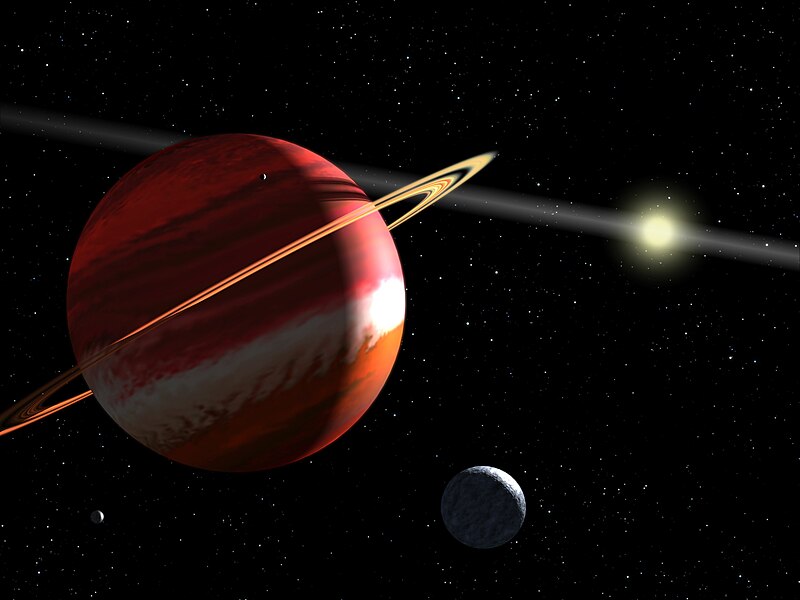 |
| Artists Impression of the planet Epsilon Eridani b (Credit: NASA, ESA) |
Thus, although currently we cannot identify an obvious specific target for Icarus, when the time comes to actually build a starship, we will have a very good idea where to send it.
My bests bet lies with the nearest system. Even though no planets have been found there yet, due to the system being the closest to the solar system at 4.4 lightyears, it will likely be chosen as a target for the first human spacecraft to fly under the light of another star.
Tuesday, 15 February 2011
Spacecraft control system developed that allows spacecraft to “think” for themselves
The first ever control system that allows satellites or spacecraft to think for themselves has been developed. Professor Sandor Veres from the University of Southampton and his team of engineers have developed an artificially intelligent control system called 'sysbrain'.
Sysbrain can read special English language technical documents using Natural Language Programming (NPL). The vehicle thereby gains advanced guidance and feedback and navigation capabilities. This can be used to better prevent crashes with other objects as well as give the vehicle the ability to adapt during missions, identify problems or carry out repair works. It can also give the vehicle the option to decide for itself how to best carry out a task based on the situation.
Special English or (sEnglish or system English) is a simplified version of English that has been used since the 1950s in special American broadcasts around the world. It uses simple grammar and vocabulary, which makes it possible for sysbrain to understand it. In the future instead of writing an update for the software, we might just write a technical paper for sysbrain to read to enhance its physical and problem solving skills.
The system could not just be applied to spacecraft, but also to other types of autonomous vehicles, be that underwater, ground or in air.
This is what I'm thinking:
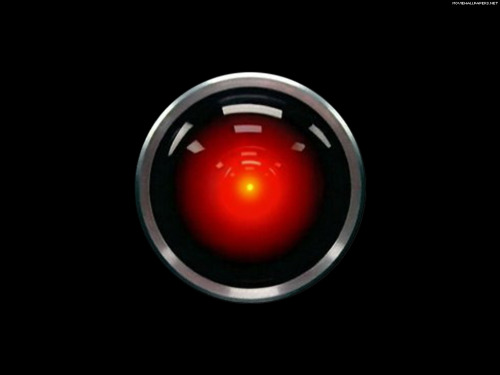 |
| “I’m sorry, Dave. I’m afraid I can’t do that.” |
Subscribe to:
Posts (Atom)