Showing posts with label space. Show all posts

Thursday, 7 April 2011

SpaceX to launch the most powerful rocket since the Apollo era

This is a bit of a follow up from my last post, which was only a video.

The new rocket, called Falcon 9-Heavy, will have a lift off power of 17 meganewtons, which makes it the most powerful rocket since Saturn V, the "Moon Rocket". The rocket should be capable of putting 53 metric tonnes of payload into orbit, which is more than twice that of the space shuttle.

The CEO of SpaceX, Elon Musk has also said that the rocket would be made safe enought to launch people. It is for example designed to meet NASA human rating safety standards. It has structural safety margins that are 40% above the actual flight loads.
The performance of the rocket could make more ambitious space missions beyond the ISS possible, although SpaceX has stressed that an even bigger rocket would be needed for any manned missions to Mars, as the equipment required for any such mission is far heavier.

The Falcon 9-Heavy. (Image Credit: SpaceX)


The first flight will take place in 2013 from Vandenberg Air Force Base with future missions also planned at Cape Canaveral in Florida.


 Animation of the Falcon 9-Heavy.

Sunday, 3 April 2011

No real blog post today, but I would like to show you guys this video.
It's a "trailer" for an anouncement by SpaceX, one of the most sophisticated of the space companies that are expected to take over the development of new spacecraft from NASA.
I am very excited about where SpaceX is going with their programme.

Thursday, 17 February 2011

Project Icarus: Visiting Other Suns?

Answer to that question is not for many years to come. But it is an interesting question.

Project Icarus is a 5 year study, headed by scientists from the Tau Zero Foundation, a non-profit group of scientists dedicated to interstellar spaceflight. The ambition of the project is designing a spacecraft and a plan for a future space mission to another planetary system.

At the moment no technology exists that would allow such a journey in a reasonable timeframe. Icarus works with the assumption that we will one day possess technology that allows us to send probes to other stars, reaching the star within 100 years after launch. Given realistic propulsion options, and the requirement that the spacecraft can slow down to orbit its target, the target star cannot be more than 15 light-years from Earth, although given that the timeframe is 100 years, the distance will likely be much less.

The second stage of the Project Daedalus interstellar spacecraft arrives at its target star system. (Credit: Adrian Mann)


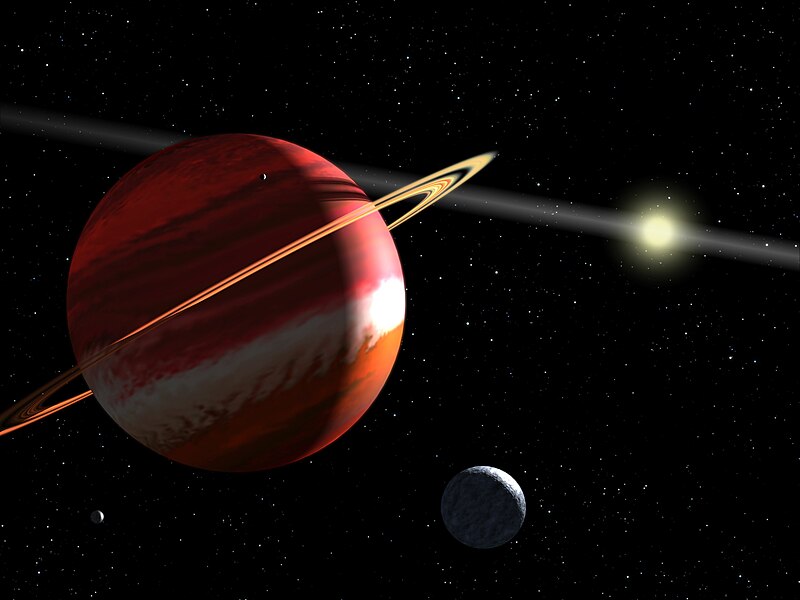
One of the factors will of course be which stars in a 15 lightyear radius will have planets. Of the 38 stellar systems (some containing more than one star) only 2 are known to have planets so far. Epsilon Eridani, 10.5 light-years away, and the red dwarf GJ 674 at a distance of 14.8 light-years.
Just outside the radius there are another 3 stars with planetary systems.
There has however to date not been a systematic survey for planets of the closest stars, which in the near future could reveal a lot more planets, by current estimates around 15 or 16.

Artists Impression of the planet Epsilon Eridani b (Credit: NASA, ESA)


Thus, although currently we cannot identify an obvious specific target for Icarus, when the time comes to actually build a starship, we will have a very good idea where to send it.

My bests bet lies with the nearest system. Even though no planets have been found there yet, due to the system being the closest to the solar system at 4.4 lightyears, it will likely be chosen as a target for the first human spacecraft to fly under the light of another star.

Tuesday, 15 February 2011

Spacecraft control system developed that allows spacecraft to “think” for themselves

The first ever control system that allows satellites or spacecraft to think for themselves has been developed. Professor Sandor Veres from the University of Southampton and his team of engineers have developed an artificially intelligent control system called 'sysbrain'.

Sysbrain can read special English language technical documents using Natural Language Programming (NPL). The vehicle thereby gains advanced guidance and feedback and navigation capabilities. This can be used to better prevent crashes with other objects as well as give the vehicle the ability to adapt during missions, identify problems or carry out repair works. It can also give the vehicle the option to decide for itself how to best carry out a task based on the situation.

Special English or (sEnglish or system English) is a simplified version of English that has been used since the 1950s in special American broadcasts around the world. It uses simple grammar and vocabulary, which makes it possible for sysbrain to understand it. In the future instead of writing an update for the software, we might just write a technical paper for sysbrain to read to enhance its physical and problem solving skills.
The system could not just be applied to spacecraft, but also to other types of autonomous vehicles, be that underwater, ground or in air.


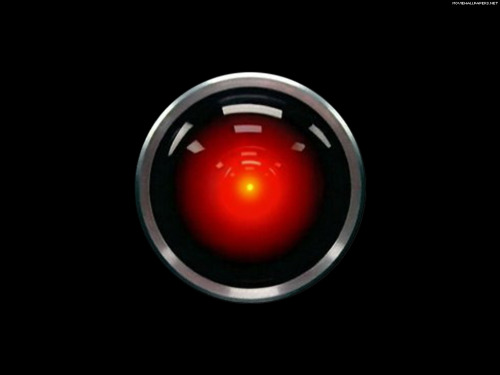
This is what I'm thinking:
I’m sorry, Dave. I’m afraid I can’t do that.”

Monday, 7 February 2011

Why the International Space Station is Valuable.

This month, the ISS will become truly international. At the moment an unmanned Russian progress space truck, and a Japanese vehicle called Kounotori are attached to the station. They came to deliver food and now serve as temporary accomodation units, and by the end of their live time will serve as garbage disposal.
Next week the European Space Agency robot delivery craft, Johannes Kepler, wich carries with it more than seven tonnes of propellant, supplies and oxygen, will join the other two craft.

The vehicle is carried into space by an Ariane 5 ES launch vehicle and give the European spaceflight programme increased independence. This will become important after the discontinuing of the NASA Space Shuttle program, later this year, when provisioning of the ISS will become dependent on the Russian Cosmodrome at Baikonur.

Artists impression of "Johannes Kepler" approaching the ISS. (Credit: ESA)

The last Space shuttle, Atlantis, will visit the ISS in June, after that other partners of NASA will supply and provide transport from and to the station.
Each shuttle launch costs NASA $ 500 million, something it can simply no longer afford. The station itself is the costliest project ever undertaken by mankind.
To say however that the station should have never been built misses the point. Occupied for more than 10 years, the station has been the only living outpost in space for that time.
Every future manned mission to space will have profited in some form from the ISS. Whether that be in how to best retrain muscles after a stay in microgravity, or experiments conducted on the effect of space on organisms.

Any future journey to the moon, or Mars, will build on lessons learned aboard the ISS.


I've realised I took a bit to come to the point here...
Anyways I'll probably write about something not space next. Although maybe the next post will be on Wednesday. I might not have enough time tomorrow.

Sunday, 6 February 2011

ESA's & NASA's Proposed Mission to Jupiter's Icy Moons

European and American scientists have been working on the joint mission which will send orbiters around Ganymed and Europa. Both moons are thought to have a liquid water ocean beneath their icy crusts, which could potentially harbour life.
The European Jupiter Ganymed Orbiter would focuss on Ganymed, the largest moon in the solar system and the only one with a significant magnetic field, which it will investigate.

The American Jupiter Europa Orbiter would instead focus on Europa, and especially on the composition of the ice field, as well as map the moon thoroughly, to identify possible future landing sites. Especially points where the ice sheeth is thinner.
It will also try to map the internal structure of the moon, which is up to now pure guesswork based on a few results. The orbiter would carry an ice penetrating radar, which could be used to estimate the thickness of the ice.
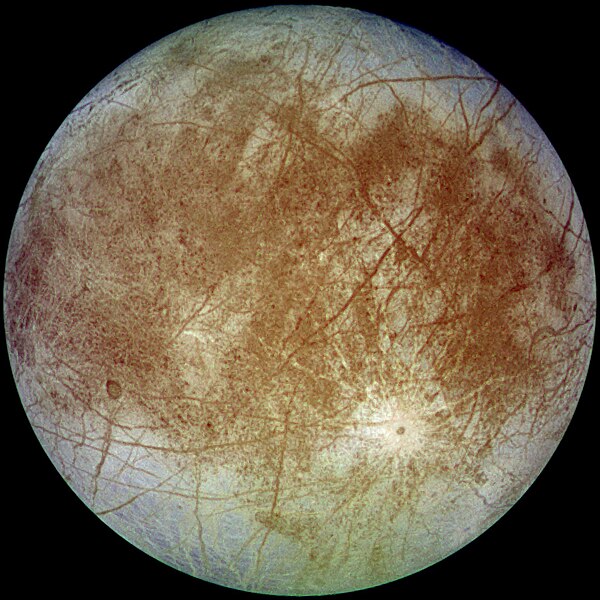
Although Europa is relatively far a way from the Sun it is kept warm by tidal heat. It's orbit around Jupiter is slightly eliptical, meaning that it is stretcehd and squashed by Jupiter's gravitational forces, which creates heat and 500 meter high tides in its interior. According to several experts life on Europa could well exist even beyond single cell microorganisms although even just finding simple bacteria would be a sensation.

Europa. The darker regions are where the water ice has a higher mineral content. (Credit: NASA)


The two orbiters will be indipendently developed by both space agencies, and each would be a significant mission in their own right. ESA is expected to name this their flagship mission for the next few years, meaning that financial support on the european side is assured. NASA has also promised support for the mission but has a larger number of other missions to pay for.

Wednesday, 2 February 2011

NASA's Kepler Spacecraft discovers potentially terrestrial planets in the habitable zone of stars

NASA's Kepler mission, which was launched in 2009, has found its first earth sized plants. Several of them could lie in the habitble zone of their stars, meaning in a suitable distance for them to be neither too hot, nor too cold.
Of the 54 new planet candidates found in the habitable zone, five are near Earth-sized. The remaining 49 range from double the size of earth up to larger than Jupiter.


The findings increase the number of planet candidates identified by Kepler to-date to 1,235. Of these, 68 are approximately Earth-size; 288 are super-Earth-size; 662 are Neptune-size; 165 are the size of Jupiter and 19 are larger than Jupiter.
This brings the total nomber of exoplanets found to nearly 1800. Considering that only half a century ago astronomers argued that there may not even be any planets around other stars this number is truly staggering.

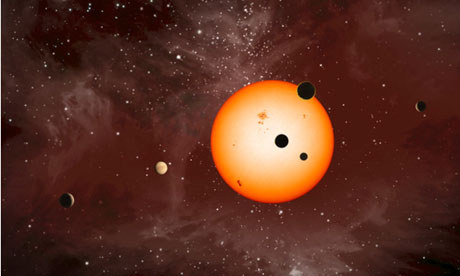
In this same release, NASA scientists anounced that they found a planetary system that beares resemblance to our own, only that it seems to be shrunk down. In the planetary system Kepler-11, six planets have been found to orbit, all of them however closer to their star than Venus in our solar system.

An artist's impression of the Kepler-11 planetary system. (Credit: Photograph: NASA/Ames/JPL-Caltech/T Pyle/Nature Magazine)

Of course all this data has to be verified and double checked by other telescopes and astronomers, however if proven this could well be one of the biggest finds ever.
It may well be that NASA has found an Earth twin in another solar system.


I will write more about exoplanets, and specifically this batch of data from Kepler as soon as more information is found or released on it.

Sunday, 30 January 2011

Privatisation of Spaceflight is coming fast

A lot of space companies have begun making headlines over the last two years.

First and foremost would be SpaceX, the company that wants to make the new NASA lauch vehicle, and seems to be succesful so far. The Falcon 9 vehicle developed by SpaceX has completed a number of test launches and flights last year. In December it carried the also SpaceX made crew capsule Dragon into space, making it the first ever commercial spacecraft in orbit to also be returned safe.
The main challenge now will be to satisfy NASA's safety requirements, which are now more then ever in the minds of people, 25 years after the Challenger accident.


Another interesting company to emerge is Excalibur Almaz. The company plans on using spacecraft based on the Soviet Space Programmes's TKS spacecraft and the Almanaz space stations (better known as Solyut 2, 3 and 5). The TKS spacecraft is unique in that it can launch atop any of several rockets of various spacefaring countries meaning that Excalibur Almaz has several possibilities for launching their vehicles.
The company plans to first flights in 2012 and begin making profit as early as 2013.
Solyut 5 (Anyone know where this image is from? I would like to give credit)


There are however also critics of commercial spaceflight saying that the industry has little experience, and that safety will be comprimised as a result. The problem with spaceflight is that it is inherently dangerous. Small errors can destroy whole spacecraft or kill crews. In 1979 a small valve opened in the returning capsule of the soviet spacecraft soyuz 11, and the 3 crew members suffocated.
With experience and testing however space flight should slowly become safer and then eventually more accessible. In the early years it will be massively expensive to even go on a "space holiday", but in years to come the price should come down slowly as technology advances and becomes more readily available.


What's your stance on privatising space exploration or "space companies"?
Would anyone else really like to live in a space station for a while? Or for a holiday? ;)

Thursday, 27 January 2011

NASA deploys its first solar sail in Low Earth Orbit.

Engineers at NASA's Marshall Space Flight Center in Huntsville, Ala., confirmed on Friday the 21st of January that the NanoSail-D nanosatellite deployed its 100-square-foot polymer sail in low-Earth orbit and is operating as planned. Actual deployment occurred on Jan. 20 at 10 p.m. EST.
Artist concept of a solar sail in space. (Credit: NASA)


"This is tremendous news and the first time NASA has deployed a solar sail in low-Earth orbit"
said Dean Alhorn, NanoSail-D principal investigator and aerospace engineer at the Marshall Center.

On the 10th of June 2010, half a year earlier the Japanese Space agency successfully unfolded their first live testing of a Solar Sail, a project called Ikaros.


The principle behind solar sailing is relatively simple. Photons, or particles of light, falling on a highly reflective, ultra-thin surface will exert a pressure. This pressure will in turn push the spacecraft forwards. This relatively simple technology has the potential to save vast amounts of fuel, potentially for interplanetary exploration, and already now it helps geostationary satellites around the earth keep their orbit at correct altitudes and saves them bringing extra fuel.

There are currently two main problems facing this relatively new method of propulsion.

  • One is the fact that the area of the sail has to be huge. Unfolding it is a challenge, as due to the fact that it has to be ultra-thin, the sail rips easily
  • The other big problem is the fact that the material is not efficient enough at the moment and a lot of potential propulsion is lost. 
Should these issues however be overcome, then in the future more satellites and space probes will be propelled using solar sails.