Showing posts with label ESA. Show all posts

Monday, 7 February 2011

Why the International Space Station is Valuable.

This month, the ISS will become truly international. At the moment an unmanned Russian progress space truck, and a Japanese vehicle called Kounotori are attached to the station. They came to deliver food and now serve as temporary accomodation units, and by the end of their live time will serve as garbage disposal.
Next week the European Space Agency robot delivery craft, Johannes Kepler, wich carries with it more than seven tonnes of propellant, supplies and oxygen, will join the other two craft.

The vehicle is carried into space by an Ariane 5 ES launch vehicle and give the European spaceflight programme increased independence. This will become important after the discontinuing of the NASA Space Shuttle program, later this year, when provisioning of the ISS will become dependent on the Russian Cosmodrome at Baikonur.

Artists impression of "Johannes Kepler" approaching the ISS. (Credit: ESA)

The last Space shuttle, Atlantis, will visit the ISS in June, after that other partners of NASA will supply and provide transport from and to the station.
Each shuttle launch costs NASA $ 500 million, something it can simply no longer afford. The station itself is the costliest project ever undertaken by mankind.
To say however that the station should have never been built misses the point. Occupied for more than 10 years, the station has been the only living outpost in space for that time.
Every future manned mission to space will have profited in some form from the ISS. Whether that be in how to best retrain muscles after a stay in microgravity, or experiments conducted on the effect of space on organisms.

Any future journey to the moon, or Mars, will build on lessons learned aboard the ISS.


I've realised I took a bit to come to the point here...
Anyways I'll probably write about something not space next. Although maybe the next post will be on Wednesday. I might not have enough time tomorrow.

Sunday, 6 February 2011

ESA's & NASA's Proposed Mission to Jupiter's Icy Moons

European and American scientists have been working on the joint mission which will send orbiters around Ganymed and Europa. Both moons are thought to have a liquid water ocean beneath their icy crusts, which could potentially harbour life.
The European Jupiter Ganymed Orbiter would focuss on Ganymed, the largest moon in the solar system and the only one with a significant magnetic field, which it will investigate.

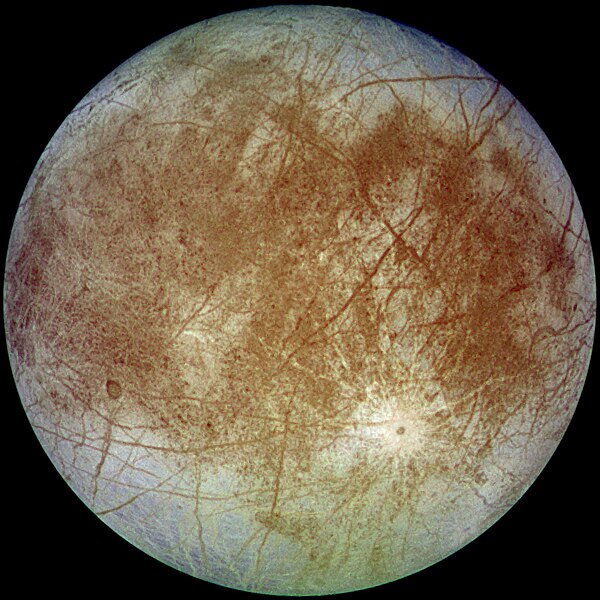
The American Jupiter Europa Orbiter would instead focus on Europa, and especially on the composition of the ice field, as well as map the moon thoroughly, to identify possible future landing sites. Especially points where the ice sheeth is thinner.
It will also try to map the internal structure of the moon, which is up to now pure guesswork based on a few results. The orbiter would carry an ice penetrating radar, which could be used to estimate the thickness of the ice.
Although Europa is relatively far a way from the Sun it is kept warm by tidal heat. It's orbit around Jupiter is slightly eliptical, meaning that it is stretcehd and squashed by Jupiter's gravitational forces, which creates heat and 500 meter high tides in its interior. According to several experts life on Europa could well exist even beyond single cell microorganisms although even just finding simple bacteria would be a sensation.

Europa. The darker regions are where the water ice has a higher mineral content. (Credit: NASA)


The two orbiters will be indipendently developed by both space agencies, and each would be a significant mission in their own right. ESA is expected to name this their flagship mission for the next few years, meaning that financial support on the european side is assured. NASA has also promised support for the mission but has a larger number of other missions to pay for.